A very old wizard once said, “Any fool can find a rock. The real magic is learning what to do with it once it’s in your hands.” That wizard’s name was Hemlog Leverlong. He was not a very good wizard. In fact, Hemlog knew one solitary spell: how to turn a rock into a larger, harder rock.
I know it sounds useless.
He had a dream that one day he would master a second spell, and the rock would move on its own. He couldn’t get the second spell right. He would shout his magic phrase, “Muxas,” and the rock would grow bigger. Every morning, he woke up, and the first thing he would do after making a cup of roasted wormwood tea was practice his hard rock magic.
He decided that even if he couldn’t master the second mobility-life spell, he’d make the biggest rock he’d ever made. He worked himself up from a tiny pebble to a fist-sized stone, from a fist-sized stone to a paving rock, from that to something you could reasonably call a boulder if you were feeling generous and standing at the right angle.
He was sweating profusely as he made the rocks hard on this particular bright afternoon. He pushed himself to the limit. He stared proudly at the biggest, hardest rock he’d ever transmuted. A girthy slab of triumph. He wanted to go bigger.
While casting his spell, a breeze blew, and a stone pine blew pollen in his face. He sneezed.
“AhhhhhhhMaxuuuuusssssssss.”
To his astonishment, his massive boulder twitched. He heard a deep groan, and it shuddered. It sprouted legs and arms. Eyes blinked wide with wonder.
Behold his dream: a living rock golem.
To Hemlog, his big moving rock was a monument to persistence. He jumped up and down in celebration of his massive animated monolith. His gray beard and hair bounced with his delight.
In his unchecked excitement, his purple and gold inlay robe loosened and almost fell to his ankles. He caught it quickly. He struggled a bit with his tongue hanging out the side of his mouth.
In his fight with his robe, he turned around to adjust his robe with the rope. Once he secured his rope belt, he spun back to marvel at his creation. He shouted something incoherent.
Smack.
The big rock hit him in the face with tremendous force. The golem was frightened and toppled onto Hemlog with a loud thunk as it fell into the earth.
Hemlog was killed instantly.
This is not really a story about Hemlog.
I’m sorry if you were getting attached to him.
He is a small rock inside a deeper story.
Size does matter when it comes to rocks.
No, it is not a euphemism for anything profane.
See, right there.
That is on you.
That is your disgusting mind taking a perfectly clean magical disaster and dragging it into the filthy mud with its little filthy stinky shoes.
Shame on you.
Hemlog died as he lived: enthusiastically and beneath the consequences of his own magical education and infatuation with hard rocks.
What usually follows the death of a wizard is paperwork, lots of it, and a funeral attended by people hoping to inherit his hat, and perhaps a disappointed apprentice who expected a promotion with a magic tower and instead receives a pile of hard rocks.
Hemlog had no apprentice.
He had only rocks.
Unfortunately, anything that’s free or unattached will attract goblins, even free rocks. Goblins are notorious thieves.
As any sensible historian will tell you, goblins are the beginning of almost every regrettable event recorded in civilized memory.
Goblins found Hemlog, or what was visible of him.
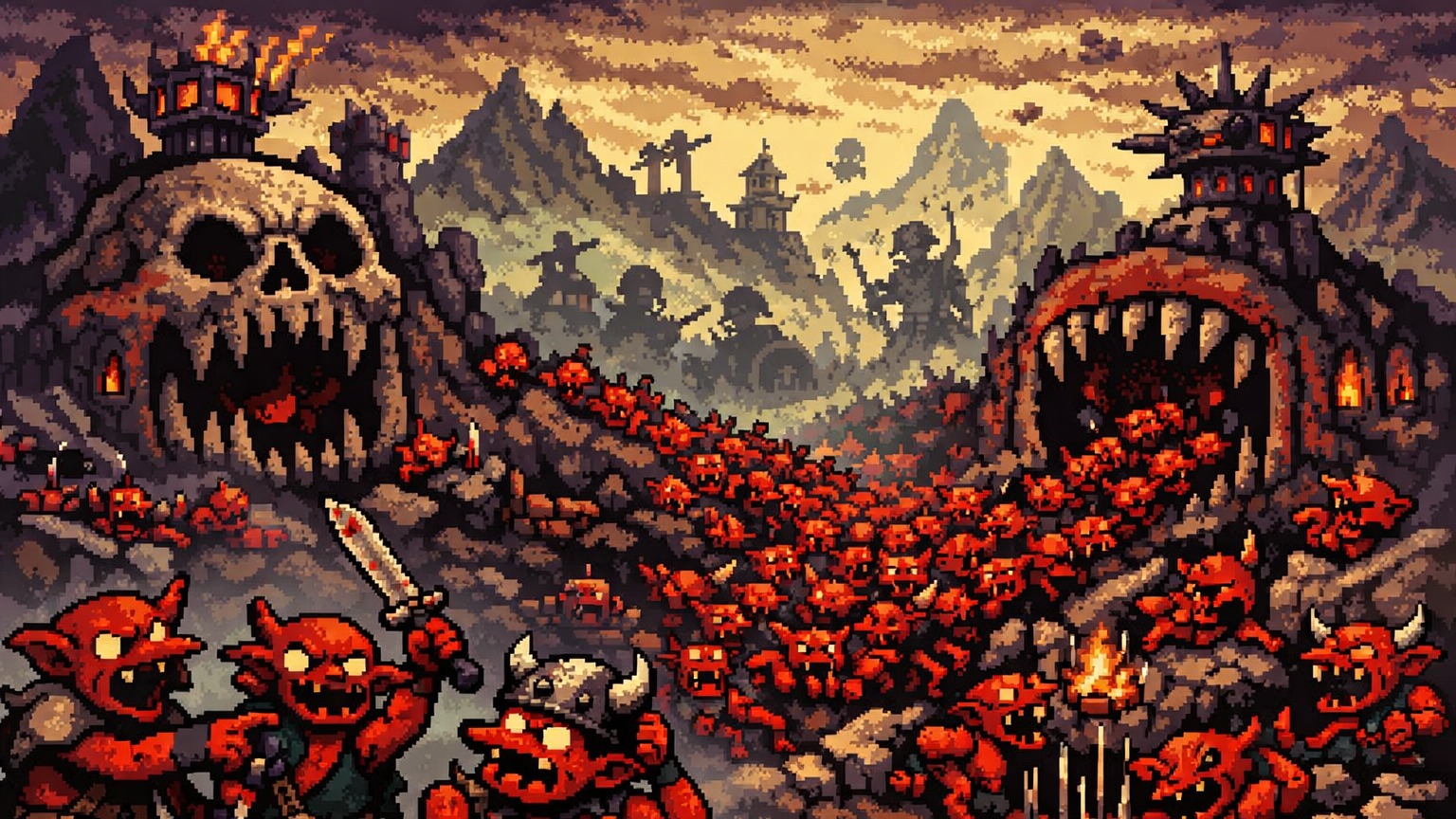
Red goblins with long bulbous noses.
Yes, red.
No, they are not green.
Whose story is this?
Have you ever seen a true goblin?
Of course not.
You read fantasy.
All of the fantasy.
Let me guess, Bolkien?
Well, Fantasy Lord, perhaps when I pass away, they will make three high-budget films from my work and hand them to a room full of lazy writers who feed on the dead.
Are you happy now?
You’ve upset me greatly.
If you keep interrupting, the story will never progress.
If you think you can do better, write your own.
Yeah, join a writing group.
Sure, they would love a story by the Fantasy Lord.
Look at me, my story was in the sensational 777, published, PHD in SSSSnakespear.
Pshhhh, get over yourself.
Let’s move on, yeah?
The goblins came in a chittering pack of seven, with their long noses, sharp little razor teeth, and ears like chewed hide. They wore belts full of stolen buttons and bird bones. Some wore large teeth of unknown creatures. They all had small, round pomegranate bombs, daggers, and small, broken hammers.
Their leader, Gourdgoble Snozzle Redsnout, was the type of goblin who believed leadership was mostly riding the largest hairy warthog and having an oversized hat with gold rings.
He had both, so he claimed leadership.
They found Hemlog under the huge rock, one bare foot sticking out, twisted at an odd angle. His wizard boot had fallen off several feet away, which made the whole thing feel less dignified than death usually pretends to be.
His hairy toes were splayed in the dirt, each one looking like a tiny person with a little mullet and an expression of deep regret. Between the toes were toe pebbles, which is goblin terminology for the small stones wedged in between a wizard's toes. Toe pebbles are high-value items in goblin trade circles, if they weren’t eaten first.
The goblins noticed the toe pebbles immediately. Goblins assign value to anything small enough to steal, ugly enough to name, and useless enough to start an argument over later.
The goblins circled the body in a loose, professional manner, with hands behind their backs.
Not professional in the sense of skill, mind you.
Professional in the sense that they had done this sort of thing before.
Goblins are opportunists.
If something dies in the woods, goblins will arrive shortly thereafter to determine whether it can be eaten, stolen, worn as a hat, or, on rare festive occasions, used as all three.
“Dead?” asked the smallest goblin, Globulus Butterknocker, as he reached for the toe pebbles.
“No. He’s just sleeping under a big rock, dumb knuckle. Save some toe pebbles for me,” said Gourdgoble with contempt at being asked such a question.
He actually had no idea if the wizard was truly dead.
“Where’s tha wizard hat?” another goblin whispered gleefully.
“Wizard hats always have spells attached to them. If he were a great wizard, his hat would fetch a fortune,” laughed Gourdgoble, nudging the boot with a stick before putting the boot on his bony, undersized foot.
“Wizard hat? More like wizard flat,” said Globulus with a sharp laugh.
“Hey. You Bobsuckle. I’m the leada here. I make the jokes.”
Gourdgoble paused with his eyes squinted.
“Find that other boot, too, you urine glackers.”
Gourdgoble scolded the laughing goblins. They stopped, spat, and shot snot rockets in agreement.
The goblins got a large stone and a metal rod to use as a lever to pry the big rock. The golem moved very loudly.
“Uggghhh, that rod hurts, guys. Be careful,” the golem suddenly shouted.
Now, none of these goblins had ever heard of a talking rock before. If you know anything about goblins, and you clearly don’t, they don’t get surprised by anything.
“Shut your f...”
Globulus was jabbed in the ribs by Gourdgoble.
“What, ya do...?”
“Looks like you are stuck, big fella. Let us help you out.”
Gourdgoble looked at Globulus menacingly.
“What does the yard say?”
“Oh yeah,” declared Globulus with a wink. “Help out the big rock man.”
“Friend now,” said the golem.
“What’s your name, big guy?” asked Gourdgoble.
“Funny hat called me AgggghmyheadImbeingcrushed before he hid from me.”
“Uhhhhhh...”
Gourdgoble closed his eyes and nodded. He was confident in his choice.
“I’ma call ya, Brock. It’s a good name.”
There were grumbles. He opened his eyes to see who disagreed. No one spoke out loud because of the hat.
By dusk, they had moved Brock off of Hemlog.
Only Globulus died in the process, which is pretty good safety numbers for goblins.
The goblins all peed on Globulus’s dead body, as is goblin tradition.
Yup, it’s really a thing.
It’s a goblin custom.
You don’t have to like something that is a traditional custom in another culture.
Let’s not focus on that.
With one more combined heave, Brock rose in a shower of dirt, leaned to one side, and took three full minutes to understand what standing meant.
He was thick.
Thick as a brick.
Then he lumbered forward and crushed a shrub with solemn confidence.
Now, a goblin gang with a rock servant might not sound like a major historical turning point.
History, however, is not shaped by impressive beginnings.
It is shaped by small mistakes that continue long enough for someone important to notice me.
Brock was not clever.
Goblins were not disciplined.
But together they possessed something far more dangerous: confidence.
This was how the trouble began.
Not all at once, of course.
Big trouble never arrives in boots and a banner.
It comes from big unforeseen rocks.
First, a bumpy trade cart road.
Then a toll path claimed by red goblins and their poorly made rock servant, Brock.
After many successful robberies, the wrong nobleman was extorted and sent back to town with a note. Word got back to other noblemen.
The unthinkable happened.
Change only happens when the rich are affected.
That note itself was not especially alarming. It demanded money, threatened vague goblin consequences, and contained a crude drawing of what appeared to be a goblin wearing a hat larger than his sense of proportion.
What was alarming was what arrived two days later.
Another letter.
Then another.
None of them demanded money.
All of them contained poetry.
Really bad poetry.
Flash fiction asterisk.
The court became deeply uncomfortable.
That was when the underpaid warrior of the rich was sent.
Now, mind you, when the nobility encounter a problem involving goblins, romance, and poetry, their usual solution is to pretend it will resolve itself quietly.
This strategy works remarkably well until it does not.
By the time the fourth poem arrived, it was clear the situation was not resolving itself.
It was escalating.
That was when Monay the Birch was summoned, and she was exactly the sort of person one sends when wizard hats get used for taking rich money.
The king started using the word “situation” too often.
Monay was dispatched to address the urgent situation.
Her broad shoulders commanded respect.
Her hair was the color of dark oak bark with a single ample braid.
She expected doors to be unreasonable, and her face did not elicit smiles.
She wore plain leather armor and carried a heavy Damascus broadsword.
She was tougher than snog meat.
Let’s hold hands for a moment.
A snog is something like a deer mixed with a large reptile.
It’s not a mammal or a reptile.
They grow to massive proportions.
They have hair, scales, and antlers, and if, for any reason, you have to eat one, you have to boil the meat for a full day.
Well, saying “snog” doesn’t mean much unless you can understand it.
Monay singlehandedly held the Dongotaur mountain pass for six hours against Devorian raiders who had only had the decency to lose their heads.
You know, Ebobstapping, they’ll not describe how impressive a seven-foot-tall Devorian raider is in black metal armor.
Nope.
You get no extra lore.
When magic was mentioned, Monay bit her tongue and automatically inhaled.
She only tolerated magic the way some people tolerate geese with the little sharp beak teeth: with caution, distance, and a readiness to punch them shits if necduke’sry.
Sorry for the lack of kindness encountered, in respect of devil’s work.
The royal steward, Landon, met her in the royal map room.
He gestured with a palm upright and a slight, rapid finger wiggle that seemed way too practiced.
Monay went to a table covered in broken figurines. She rolled her eyes and inhaled, trying to ground herself.
“The king, despite border treaties, armed patrols, and generations of mutual hatred, would like to know if you have read the reports,” he said, staring ahead as if talking to someone ten feet away.
“I know what love can accomplish,” Monay said, “but the wheezing one has explained it to me by someone who looks like your cousin. You all look like you're a hundred years old, and you are all related. Discuss ‘pure’ bloodlines.”
Opp, someone was offended.
Bye, then.
Read a safe story.
Landon winced.
“There’s a big rock man on the eastern roads.”
“A golem, with those red goblins?” Monay paced about it, caught up in thought.
“Yes, a golem. I said rock man because people understand rock man.”
“You definitely said, rock man. But goblin-made?”
“Apparently.”
He was clearly annoyed.
“Worse than wizard-made. That Hemlog has been playing with rocks. Perhaps he’s involved.”
“Considerably.”
Monay nodded.
“Then why am I here instead of the Royal Army?”
Landon shifted slowly to his left foot.
“There is another element.”
There usually was.
There always was.
If it had only been a golem monster, some cousin-cousin-brotherke would already be dead in a glorious way, and the court would have resolved the situation, probably with dead cows placed on catapults.
“What element?” Monay asked slowly.
Landon slid over a folded paper.
Monay slid it back without hesitation.
“It has a drawing,” he said, rolling his eyes.
Monay snatched the paper, opened it, and looked at the drawing.
A terrible drawing, but clearly made with feeling, which is worse.
A goblin in an oversized cap stood beneath a moon, holding what was either a rose or a radish, depending on how much generosity one brought to the art.
No pants on, with an anatomically accurate male member.
Clearly, personally, and passionately colored bright red.
Beside him stood Lady Essel of Westmord, daughter of Duke Alewine, a small, alphabetized woman in the middle of a very bad decision.
Monay stared at the page.
“No.”
“I am afraid, yes.”
“No, I mean no. I refuse it.”
“There are letters. To be married...”
“No, no, no.”
Her hand waved away the idea of it.
Her face scrunched.
“Yes!”
“Absolutely not.”
Her anger was rising.
That’s the denial joke.
It went on too long, and Landon drew a second folded paper from his sleeve, like a court jester producing a kerchief.
We beat the snog enough.
“There was also poetry.”
Monay closed her eyes in pain.
Outside, somewhere in the courtyard, a royal peacock squawked, its soul being tormented.
“Show me,” she said clearly, frustrated.
The poetry was beyond terribly written in Goblin.
My Love, Butter churns rusted gears, You are prettier and melt like warm ice, Your eyes look like my mother’s and my grandmother’s. Beauteous hearts with me. The moon is like your shadow.
“Stop,” Monay said, grabbing her jaw as she shook.
Its grammar staggered.
Its spelling was limp.
Landon continued the torture.
One line compared Lady Essel’s eyes to two wet “Lilly pads in a duck pond.” Another described lovelyion as “exhibition day, moist meats.”
Suddenly, Monay no longer looked offended.
She looked thoughtful.
She paced in front of a window.
Which was unusual, because most people who heard the herd looked ill.
“Something wrong?” Landon asked cautiously.
Monay turned and read the poem, tapping the page.
“This goblin,” she said slowly, “is trying very hard.”
Landon blinked.
“Trying hard to what?”
“Court her, you idiot.”
Silence settled over the room like a dropped anvil.
“That’s absurd,” Landon said.
Monay shrugged.
“Kidnappers do not usually send poems.”
Landon lowered the page slowly.
“Well?” he asked.
She frowned, with her hand resting on her chin.
“She encountered him while riding with her uncle? Let me see the first note the duke brought back. It was all words.”
“Go on, read it,” she said.
Landon cleared his throat loudly.
“Ughhhhhh. Hmmmm...”
He paused briefly. His voice changed.
“Give me all the monies, you rod-bobbing, bobsuckle, snog-dung-eating, frog-pickle, snard-snarling, geese-swaddling, fart-tickles...”
Monay began laughing uncontrollably. She was doubled over as if she were in pain. She was wheezing.
“Continue, please.”
Landon composed himself and continued the reading.
“I, Gourdgob, with the help of Leapeddy Essel, have become the strongest writer and poet. I will spare the duke’s life for the reward of kindness that is expected of the most beautiful in the Kingdom of Dummel. Send gold.”
“I hate to say it. I believe he means it. The poetry came later?”
“Yes.”
“This looks like it was a bad liaison,” Monay said, as if closing the matter.
Monay concluded that Lady Essel had disappeared into goblin country willingly, apparently convinced that love could do what border treaties, armed patrols, and generations of mutual hatred had failed to accomplish.
Worse, she had done so near the old drowned gate at Blackwater Inlet, a place sealed three hundred years earlier for reasons no one discussed openly.
Monay said nothing further about the matter. She folded the poem carefully and placed it inside her belt.
Not because she liked it.
Because she was always thinking.
Monay the Birch had a reputation for solving problems with a great sword. What most people failed to notice was that she usually solved them with keen observation first.
The sword cut through the parts that refused to cooperate.
Asterisk to hold the reader’s hand.
The journey east took three days.
On the second day, Monay killed Brock with a wedge hammer and her fierce brow.
What do you mean you liked Brock?
He seemed sweet?
You didn’t see him.
He was ugly with moss, dripping with mud, and covered with cochlea beetles....
Fine.
He lived.
Bastard.
Know your audience, sure, always with a happy ending.
As she traveled east, Monay kept turning the poem over in her mind.
The spelling was terrible.
The metaphors were worse.
But the effort was genuine.
Someone had taught the goblin to write.
Or the goblin had taught himself.
Either way, that was not the behavior of a creature engaged in traditional kidnapping.
On the third day, she had to fist-fight an orc outside a burnt watchtower.
Yes, an orc.
Yellow.
Orcs are yellow; don’t start.
Its face was left lumpy and sad once she beat him off with her knightly hands, and if you so much as breathe wrong at that sentence, I will personally come into your house and sort your books by size in the night.
I can tell you are the type that alphabetizes by author’s last name.
So help me.
“Look at me, I sound like a tiny heckling mouse with my cheeeese.”
The orc had challenged her honor, her map reading, and her understanding of swordsmanship. She broke his nose, loosened three teeth, and threw him into an ale barrel where he reconsidered several yellow orc life choices, though not enough of them.
By twilight, she found the red goblin camp.
By the time Monay reached the cedar grove, she had already concluded.
The court believed Lady Essel had been abducted.
Monay suspected something far more dangerous.
That Lady Essel had gone willingly.
It sprawled in the roots of a dead cedar, lanterns hung from nails, red goblins darted about with baskets and knives, and the manic self-importance of people hosting an event beyond their social station.
They had been breeding rock golems, and they stood around the clearing like badly carved totems.
Some wore curtains.
One had a bell tied to its arm.
Another had a beard made of moss.
In the center, beneath a string of stolen artifacts and wild game sausages, sat Lady Essel and Gourdgoble Redsnout.
She was lovely in the exhausting, aristocratic way. She reminded Monay of Landon.
She shuddered.
He was a red goblin in a feathered cap with an overbite and a posture full of doomed sincerity.
Between them sat a plate of bugleberry mushrooms and two cups of blackberry wine.
They were, unbelievably, holding hands.
No, not like that.
With tenderness.
You see? Words have uses beyond scandal if you stop pawing at them.
Monay watched from the brush as Essel leaned in.
“If they would only listen,” she said.
“They never listen,” Gourdgoble said. “That is why I write verse.”
“You must stop writing verse,” Monay pleaded.
“I write from the wound.”
“You write from a shite stinking swamp.”
He looked injured as he clutched his heart.
It might have been funny if the drowned gate had not been thirty yards behind them, half buried in reeds and black abarack stone, carved with tentacles and moon runes and the sort of warning imagery one ought not to ignore.
Several goblins were hauling chains off their hinges while the rock golems pulled at the doors.
Monay rose from the brush and stepped into the firelight.
“No one is opening anything,” she said.
The camp exploded.
Goblins shrieked.
One dropped a ladle.
Another fainted artistically into a basket of wild turnips.
Gourdgoble leaped up and drew a thin dagger. To him, it was a sword entirely too elegant for him.
Essel stood so quickly that she kicked over the wine.
“Monay?” she shrieked.
“Yes.”
“Oh, good.”
“Good?”
“I was hoping they’d send someone reasonable.”
“Instead of what?”
“A shite bishop.”
Fair enough.
Monay advanced toward the gate.
“Step away from the eldritch hinges.”
Gourdgoble drew himself up to his full, unimpressive height.
“You stand before true love,” he said.
“I stand before a border incident wearing an oversized hat.”
Essel flinched.
Gourdgoble looked wounded but not, I admit, entirely undeserving.